One Nation, Under Potholes
One Nation, Under Potholes
The midterms are over. Here’s the one thing we can still all agree on — and the one extra step that keeps cities from patching the same hole every three weeks.
The yard signs are down. Part of the country is thrilled, part is in mourning, and the rest of us are just relieved the ads are over. But drive anywhere in America this week and you’ll find the last genuinely bipartisan issue left in this country: a hole in the road roughly the size of a turkey platter, sitting exactly where you need to turn.
Ask a Republican and a Democrat how they feel about that pothole and you’ll get the same answer in the same tone of voice. It’s bad. Fix it.
So why don’t we?
The money is there. It’s just going somewhere else.
Here’s the question that gnaws at people. Your city can find money for another camera, another license plate reader, another dashboard nobody opens. Fair enough — public safety technology has a real job to do. But the road underneath all of it? The surface that every car, bus, ambulance, school bus, delivery van, and the 80-year-old on her way to church uses every single day? That gets a shrug and a “we’ll get to it.”
Part of the reason is visibility. A camera gets a press release. A repair that quietly holds for a decade gets nothing.
Meanwhile the bill arrives anyway. AAA found that in 2021, 1 in 10 U.S. drivers hit a pothole hard enough to need a repair — at an average of almost $600 per repair — for a combined $26.5 billion in a single year. Plenty of those drivers needed two repairs. And that’s just the vehicles. New York City paid out close to $138 million over six years on defective-roadway claims, and while the car-damage claims were relatively cheap, the personal-injury claims — people who went down on broken pavement, some of whom ended up in a hospital — were not. Houston fills about 50,000 potholes a year. State and local governments were already carrying roughly $105 billion in deferred road and bridge maintenance as of 2023.
A city can spend a fortune responding to potholes and still not be doing anything about potholes.
The repair was never designed to last
Here’s the part almost nobody says out loud. Pothole patching is a temporary repair. Water gets into the patch, freezes, expands, and pushes the repair apart from underneath. Traffic finishes the job.
The crews are not bad at this. They’re simply doing a temporary repair and expecting it to last. Every return trip — crew, truck, material, cones, traffic control, another worker standing in a live lane — is money spent to solve the same problem again and again. Ask anyone who runs a crew; they will tell you that the more times a pothole is patched, the more each patch costs. By then, the crew knows the address by heart.
The missing step (30-second version)
This is where American Road Patch comes in, and the pitch is almost embarrassingly small. Keep your crews. Keep your trucks. Keep your cold patch, your hot mix, your infrared unit, your bid process, your politics. Just add one last step: after the hole is filled and compacted, seal the repair with a peel-and-seal membrane that bonds into the surrounding pavement, contains the repair, and seals water out.
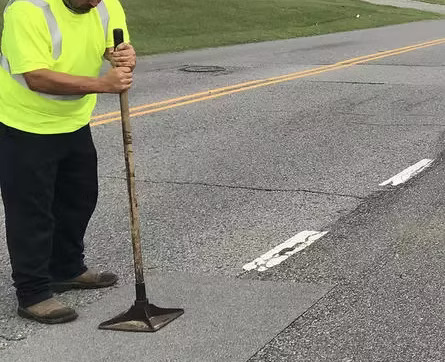
Think of it as a screen protector for a repair. American Road Patch is built around a high-strength fiberglass grid, goes down over the finished patch and a few inches past it, and becomes part of the road as traffic rolls over it. It isn’t a filler, and it isn’t a replacement for anything you already do. Installation takes about five minutes, needs no special equipment, and traffic can roll the moment you’re done. It’s built to survive plows, street sweepers, and freeze-thaw cycles, and according to the company it can extend the life of a pothole repair by 10 years or more — backed by third-party testing (British Board of Agrément HAPAS certificate 25/H7403, which tested bond strength, skid resistance, and impermeability) and test sites that have been holding up for more than eight years.
Ten years, not ten weeks. Imagine not getting the same call about the same hole until 2036.
The math that gets budget directors out of bed
American Road Patch costs more per hole than a scoop of cold patch. It costs far less per decade. That’s the entire argument.
Say your city fills 2,000 potholes a year, and 70% of them need two repeat visits within a year. That’s 2,800 return trips. At $150–$250 per visit — labor, truck, material, and traffic control — you’re spending $420,000 to $700,000 a year to re-fix holes you already fixed. Over ten years, that’s $4.2 million to $7 million, and now the roads are in worse shape.
A single 72-square-foot roll of American Road Patch covers roughly a dozen typical repairs, so the material cost per hole is modest next to even one avoided return trip. Run your own numbers — every city is different — but the shape of the math doesn’t change:
Labor: the same crew hours, spent on new problems instead of old ones.
Equipment: the same trucks covering more ground, with fewer repeat trips for material and fuel.
Traffic control: fewer cones, fewer lane closures, fewer complaints.
Claims: fewer damaged cars, fewer injured pedestrians, fewer settlements.
Safety: fewer work zones, and fewer times your people stand in live traffic for a hole you already fixed.
Capacity: the backlog you’ve been ignoring finally gets a crew.
That last one is the real savings. Not fewer people — the same people, finally working on new problems instead of the same old hole.
What cities say when the callbacks stop
Missouri DOT’s St. Louis Metro District tested it and came back with a mild complaint: “When we placed this material down, we had no idea how well it would perform. Now, we wish we had asked [for a] longer test section. After four years of traffic and weather, the patch is performing beyond our expectations. And no damage from snowplows.”
EJ Prescott, a Northeast distributor, says the municipalities they supply “are very impressed with how easily it installs, and how well it holds up through our harsh Northeast winters.” Brishan Inc. calls it “the fix that all road maintenance crews have been searching for,” adding that “the surprise comes when they see how simple it is to use.” Brock White in Canada frames it in budget terms: ideal “for saving on the long-term repair costs of our infrastructures.”
Municipalities using it are, by every account we get, over the moon — though what they usually talk about is relief. The callbacks stopped. The crew stopped memorizing the address. The budget stopped bleeding in the same spot every spring.
Don’t change a thing. Just do it before the first freeze.
No reorganization. No new spec. Fill the pothole the way you always have, seal it, and drive away. That’s it. That’s the change.
One timing note, though: stock up now. Pothole season starts with the first freeze-thaw, and that’s when every crew, truck, and hour is already spoken for. You can install American Road Patch in cold weather — you just have to heat the pavement surface with an infrared heater or torch first, and keep it dry. In warmer weather it’s peel, place, tamp, done. Easier work, better bond, fewer winter surprises.
So before the first storm eats your calendar: find a distributor near you and get a few rolls on the shelf. Municipalities interested in a documented pilot can contact the American Road Patch team directly.
Fix it once. Then go fix something else.
Sources
AAA, “Potholes Pack a Punch as Drivers Pay $26.5 Billion in Related Vehicle Repairs” (2022): https://newsroom.aaa.com/2022/03/aaa-potholes-pack-a-punch-as-drivers-pay-26-5-billion-in-related-vehicle-repairs/
NYC Comptroller, ClaimStat Alert on defective roadways (2015): https://comptroller.nyc.gov/newsroom/claimstat-alert-defective-roadways-put-138-million-hole-in-new-york-citys-budget-over-last-6-years/
City of Houston Potholes Tracker FAQ: https://www.houstonpotholes.org/faq.html
The Pew Charitable Trusts, deferred maintenance for roads and bridges (2025): https://www.pew.org/en/research-and-analysis/issue-briefs/2025/05/state-and-local-governments-face-105-billion-in-deferred-maintenance-for-roads-and-bridges
American Road Patch testimonials: https://americanroadpatch.com/testimonials
Saint-Gobain ADFORS, American Road Patch installation instructions: https://www.adfors.com/sites/hps-mac3-adfors-us/files/2021-07/American%20Road%20Patch%20Instruction%20sheet.pdf