We Got an Email from Brazil That Stopped Us in Our Tracks
We Got an Email from Brazil That Stopped Us in Our Tracks
We knew our product worked. We have the test sites, the case studies, the independent certifications, and the testimonials to prove it. But last week, we received an email from our master distributor in Brazil — specifically the Business Development Engineer at Saint-Gobain — and it genuinely stopped us in our tracks.
She had done the math.
Not just the performance math. The carbon math.
She had taken the time to run a full emissions comparison between a standard pothole repair and a repair sealed with American Road Patch. And the number she led with was simple, clean, and impossible to ignore:
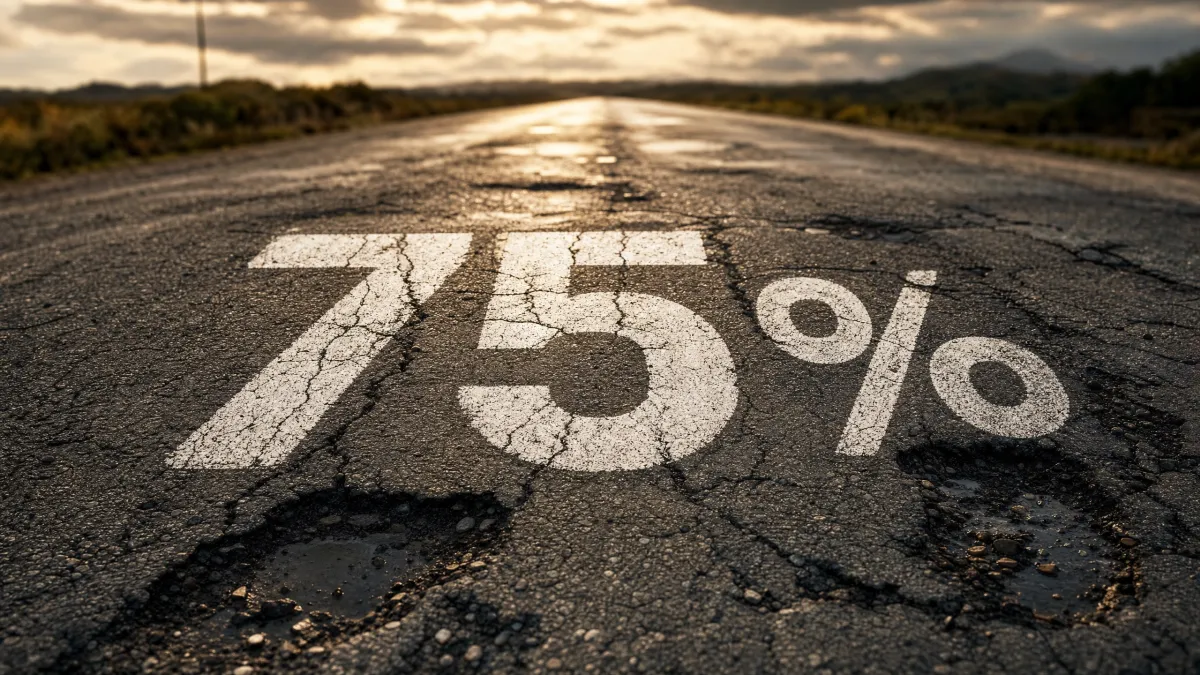
75%.
For a single pothole — just 30 centimeters wide and 5 centimeters deep — ARP reduces CO₂ emissions by 75% compared to a standard asphalt fill left unsealed. A conventional repair generates 2.0 kg of CO₂ in materials alone. ARP brings that down to 0.5 kg. And that gap gets even wider when you factor in transportation and material disposal — CO₂ emissions are four times higher with a standard fill when you look at the full picture.
Then she went one step further. To make the cumulative impact feel tangible, she calculated what 1,000 ARP repairs would save: approximately 1.5 metric tons of CO₂. And she put it in terms any Brazilian would immediately picture — the same emissions produced by 35 gas car trips between São Paulo and Rio de Janeiro.
We knew the numbers were good. We did not know they were that good.
We Wanted to Put It in Context for the US
The São Paulo to Rio de Janeiro comparison is perfect — if you are Brazilian. For the rest of us, it takes a second to land.
So we looked it up. São Paulo to Rio is about 435 kilometers, or roughly 270 miles. We pulled up a map, found the closest American equivalent, and it was almost too perfect: Los Angeles to Las Vegas. Nearly identical distance. A road trip every American can picture.
Same math. Same 75% reduction in CO₂. Same 1.5 tons saved per 1,000 repairs. And to make that 1.5 tons feel real — same 35 gas car trips, just on a route that hits differently when you can picture the I-15 stretching out through the Mojave.
The car trip is a fun way to visualize the scale. But the number that matters every single time a crew fills a pothole is the 75%. That is the one to remember.
And that got us thinking about the bigger picture here in the US. The United States has approximately 4.2 million miles of roads . The American Society of Civil Engineers gave those roads a D+ grade, with a repair backlog approaching $700 billion . According to AAA, pothole-related vehicle damage costs American drivers $26.5 billion every single year .
We are not winning the war on potholes. And a big part of the reason is that the industry keeps fighting it the same way — fill the hole, leave it exposed, watch it fail, repeat.
That cycle is not just expensive. It is also an environmental disaster hiding in plain sight.
What Is American Road Patch?
If you are new here, let us back up for a second.
American Road Patch is not a new type of asphalt. It is not a filler. It is the final sealing step that makes a pothole repair permanent — the step that the entire industry has been skipping for decades.
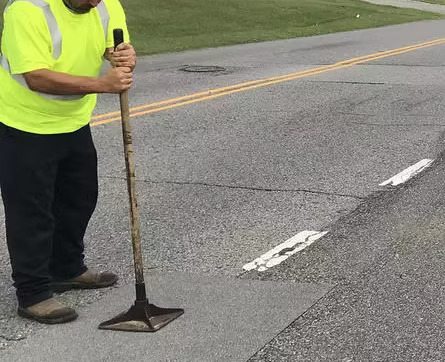
Here is how it works: when a pothole forms, crews fill it with cold or hot asphalt. That part stays the same. What changes is what happens next. Instead of leaving that fresh fill exposed to the elements, you apply ARP — a patented, peel-and-seal membrane reinforced with a high-strength fiberglass grid — directly over the top of the repair. It bonds to the road surface, creates a watertight barrier, and locks the fill material in place.
Think of it like grouting tile. Or shingling a roof. Every process has a critical finishing step that protects the work underneath. For decades, pothole repair has been skipping that step entirely.
Without a seal, water seeps into the microscopic cracks around the patch. It freezes. It expands. It breaks the repair apart from the inside out. Traffic does the rest. And within weeks or months — sometimes sooner — the same pothole is back, often worse than before.
ARP stops that cycle cold. If water cannot get in, the freeze-thaw cycle cannot destroy the patch.
Repairs sealed with ARP have been documented lasting upwards of 10 years in real-world conditions — under F-16 fighter jet traffic in Minnesota, under 80,000-pound semi-trucks in Indiana, and through world-record floods in Malaysia 4.
The Environmental Story Nobody Was Telling
Here is the part that email unlocked for us — and honestly, the part we had never fully articulated before.
The sustainability case for ARP is not just about using less material per repair. It is about the fact that you only repair it once.
A standard asphalt fill that fails in three months does not just cost you money the second time around. It costs the planet. Every repeat repair means more materials manufactured, more trucks on the road, more equipment running, more old asphalt ripped out and disposed of. Multiply that across millions of potholes, repeated year after year, and the carbon footprint of conventional road maintenance is enormous — and almost entirely invisible.
ARP collapses that cycle. One repair. No repeat visits. No wasted materials. No unnecessary emissions.
And there is one more environmental angle that rarely gets mentioned: what happens to the fill material when a standard repair fails.
It does not disappear. It breaks apart and washes off the road surface into storm drains, streams, rivers, and eventually the ocean. By sealing and containing the repair material inside the road, ARP prevents that runoff entirely. It is a small thing on any individual repair — but across millions of potholes, it adds up to a meaningful reduction in asphalt pollution entering our waterways.
Proven in the Real World
We do not just make claims. We have the data to back them up.
At the National Center for Asphalt Technology (NCAT), ARP endured 1.3 million Equivalent Single Axle Loads (ESALs) — years of heavy truck traffic — while maintaining safe friction levels throughout 4. It holds BBA HAPAS certification from the British Board of Agrément, having passed rigorous assessments for impermeability, tensile strength, skid resistance, and surface texture 4.
And the real-world results speak for themselves:
Duluth Airport Authority Taxiway, Minnesota — Repaired in 2019 under F-16 traffic and brutal winters. Still intact today.
Heavy Load Roads, Versailles, Indiana — Recurring potholes under 80,000-lb semi-trucks. Installed ARP. No further cracking.
Buenos Aires Bridges, Argentina — 2,700 m² across five major bridges. Certified good performance by local authorities thirteen months later.
"When we placed this material down, we had no idea how well it would perform. Now, we wish we had asked for a longer test section."— Missouri DOT, St. Louis Metro District
Where to Get It
American Road Patch is available worldwide through a growing network of distributors. If you are in the US, there is almost certainly a regional partner near you. We also have distribution across Canada, the Caribbean, South America, Southeast Asia, the UK, and Ireland.
Find a distributor at americanroadpatch.com →
And if you are reading this from a region that is not yet covered — or you are in the industry and see the opportunity here — we are actively looking for new distribution partners as demand continues to grow.
Reach out to explore distribution opportunities →
One Last Thing
That is the thing about a product that actually works — the numbers do the talking. You do not need to oversell it. You just have to make sure people hear them.
A huge thank you to the Business Development Engineer at Saint-Gobain Brazil for taking the time to run this analysis and share it with us. We see you, we appreciate you, and this one is for you.
Don't just fill it. Seal it.
References
[1] Statista. U.S. highway mileage.
[2] Yahoo News. (2026 ). Op-Ed: Congress must avoid highway policy potholes.
[3] Automotive Fleet. (2026 ). Potholes Causing $3B in Damage Each Year.
[4] American Road Patch. (2026 ). Case Studies and Independent Testing.