The Trash Truck, the Pothole, and Why Cities Hesitate to Adopt A New System That Actually Stops Potholes For Good.
The Trash Truck, the Pothole, and Why Cities Hesitate to Adopt A New System That Actually Stops Potholes For Good.
Your municipality is not trying to waste your tax dollars. It is facing a problem public works has faced before: what happens when a safer, more effective technology disrupts the way the work has always been done?
Here is a public-works fact most people do not know.
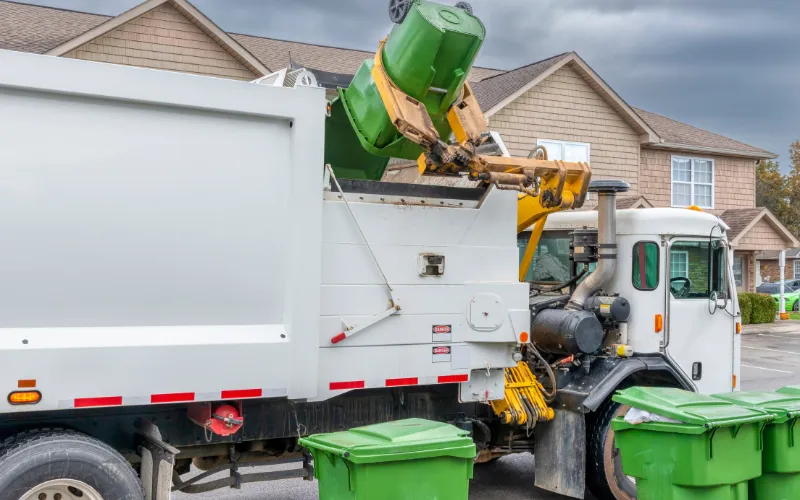
In 1969, employees in Scottsdale, Arizona, built a strange-looking garbage truck with a mechanical arm. They nicknamed it “Godzilla”. Instead of relying on workers to lift trash by hand beside moving vehicles, the driver could pick up and empty standardized containers from inside the cab. 1
Today, that sounds normal. At the time, it changed everything.
Traditional trash collection was physically punishing. Workers repeatedly climbed on and off trucks, lifted heavy containers, walked between stops, and spent much of the day exposed to traffic. Research on solid-waste collection later found that automation could reduce lifting, street exposure, injuries, and workers’ compensation costs. 2
But the new technology also raised an uncomfortable question:
If one person and a machine can do work that once required a larger crew, what happens to the workers?
Cities, employees, and unions had to rethink the job—not simply eliminate it. A 1977 U.S. Environmental Protection Agency study documented municipal plans that protected employees from layoffs and shared savings between workers and the city. In one study city, productivity gains also helped expand business collection and add a large-item pickup service. 3 Decades later, Plant City, Florida, planned its own transition through promotions, transfers, retirements, and normal attrition rather than layoffs. 4
The lesson was not that workers were unnecessary. The lesson was that their time, skills, and safety could be put to better use.
Today, the Pothole Is the Trash Truck
Municipal road departments are facing a similar question today.
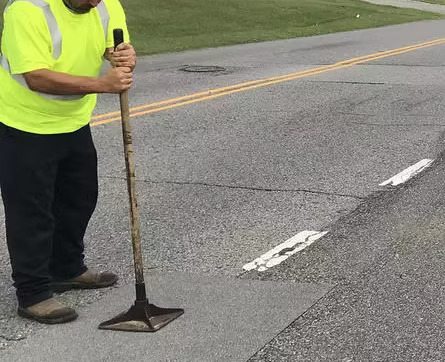
A crew fills a pothole. Water finds its way around the repair. Weather and traffic break it apart. The city sends the same workers, trucks, materials, and traffic-control equipment back to the same location again and again.
Then a product such as American Road Patch enters the conversation and promises to help the repair last. Suddenly, the old questions return.
If crews stop repairing the same potholes repeatedly, what happens to crew hours? What happens to next year’s material budget? What happens to the familiar workload used to justify staffing and equipment?
That is why some municipalities hesitate. It is not necessarily because they want repairs to fail. Public agencies are built around approved specifications, established procedures, annual budgets, and predictable workloads. A product that changes the cycle can feel like a threat before it looks like an opportunity.
But the better question is not, “What work will disappear?”
It is, “What important work can finally get done?”
Every Repeat Visit Is Also a Safety Decision
There is another cost to temporary repairs that rarely appears on the invoice: roadside exposure.
Every time a crew returns to a failed pothole, employees go back into or beside live traffic. They set up the work zone, unload equipment, complete the repair, and trust passing drivers to slow down and pay attention.
That trust carries real risk. The CDC’s National Institute for Occupational Safety and Health reported approximately 96,000 work-zone crashes, 37,000 injuries, and 891 fatalities in 2022. Of 136 pedestrians killed in work zones, 105 were workers. 5 Caltrans warns that many highway employees perform their jobs outside barricades and specifically tells motorists to avoid phones and other distractions near work zones. 6
American Road Patch cannot eliminate work-zone danger. But if a repair does not need to be repeated, the crew does not need to be exposed at that same location again.
There is no reason to jeopardize employees ten times for a pothole that could have been repaired once and protected properly.
What American Road Patch Does
American Road Patch is not pothole filler. It is the final protective layer installed over a properly completed asphalt or concrete repair.
The peel-and-seal system uses a high-strength fiberglass grid to create a reinforced, waterproof bond over the repaired area. Its purpose is to keep water out, protect the material underneath, and help prevent the deterioration cycle from restarting. American Road Patch states that the product can extend pothole-repair life by 10 years or more. 7
The product has also received third-party qualification. British Board of Agrément HAPAS Certificate 25/H7403 describes American Road Patch as a self-adhesive geotextile membrane saturated with bitumen and dressed with aggregate. Testing recorded passing results for texture, skid resistance, bond strength, and impermeability. The certificate says the product can extend a patch repair’s expected service life when it is installed according to best practices on sound surrounding pavement. 8
That is the key: fill the pothole, seal the repair, and move on.
What Road Professionals Are Saying
“When we placed this material down, we had no idea how well it would perform. Now, we wish we had asked for a longer test section. After four years of traffic and weather, the patch is performing beyond our expectations. And no damage from snowplows.”
— Missouri Department of Transportation, St. Louis Metro District 9
“We have provided American Road Patch to several municipalities who are very impressed with how easily it installs, and how well it holds up through our harsh Northeast winters.”
— EJ Prescott, Distributor 9
Change the Question
Pew estimates that state and local governments accumulated nearly $105 billion in deferred road and bridge maintenance by 2023.10 There is no shortage of work waiting for public works crews.
Stop asking | Start asking |
|---|---|
How many potholes did we fill? | How many repairs stayed repaired? |
How do we preserve repeat work? | Where can we redeploy the hours we recover? |
What material costs the least today? | What repair costs the least over its service life? |
A crew that stops revisiting the same ten potholes does not become unnecessary. That crew can move to the next road failure, utility cut, bridge joint, drainage problem, culvert, sidewalk, or ADA ramp.
That is the real lesson of the automated trash truck. Better technology did not make public works less important. It helped public works become safer, more productive, and capable of serving more people.
American Road Patch offers municipalities the same opportunity.
The question is not what a crew will do when it stops repairing the same pothole.The question is what that crew can finally fix next.
Purchase American Road Patch or Become a Distributor
Ready to make road repairs last? Visit the American Road Patch purchase page to find a distributor and purchase the product.
American Road Patch is also always accepting new distribution partners. Thousands of customers visit the American Road Patch website each month looking to purchase the product. If you are interested in serving that demand, contact American Road Patch to start the conversation.
Municipalities interested in a documented pilot can also contact the American Road Patch team.
References
[1] Godzilla Turns 50: A Monstrous Story of Innovation — Engaging Local Government Leaders
[2] Worker Safety in Solid Waste Collection — MSW Management
[3] Incentives for Solid Waste Collection Personnel — U.S. Environmental Protection Agency
[4] What Will Happen to the Solid Waste Employees? — Plant City, Florida
[5] Highway Work Zone Safety — CDC/NIOSH
[6] Work Zone Safety — Caltrans
[7] American Road Patch | Best Pothole Repair
[8] BBA HAPAS Certificate 25/H7403 — American Road Patch